镜子超人
Climate Gambit: Chinese team develops ‘super brain’ to guide flood precautions using weather, hydraulic and terrain data_我的网站

一 | NEW YORK -- Americans showed their steadfast resilience and kept spending online, at restaurants and other outlets in September even as they grappled with higher prices, rising interest rates and a host of other headwinds piling up.Retail sales rose 0.7% in September, more than twice what economists had expected, and close to a revised 0.8% bump in August, the Commerce Department reported Tuesday. Retail sales in August were inflated after gasoline prices spiked, however. That was not the case in September when gas prices rose more slowly.A closely watched category of retail sales that excludes auto dealers, gas stations and building materials and feeds into the gross domestic product jumped 0.6% last month compared to the prior month.Tuesday's sales figures aren't adjusted for inflation, but the cost of goods barely rose last month, so the increased spending isn't a reflection of higher prices. Prices for durable goods, such as those sold by appliance and electronics stores, actually fell last month.The government’s monthly retail sales report offers only a partial look at consumer spending; it doesn’t include many services, including health care, travel and hotel lodging. But it does cover spending at restaurants, which had a solid 0.9% increase. Spending online rose 1.1% last month, according to the report. Sales at general merchandise stores rose 0.4%. Sales at home furnishings and furniture stores were flat, while electronics stores and outlets that sell building materials saw declines reflecting a difficult housing market. The retail sales report, which reflects the sixth consecutive monthly gain, reinforces the fact that American consumers, as a whole, are showing no signs of pulling back on their spending, which powers most of the economy. That spending comes despite attempts by the Federal Reserve to cool spending and hiring. That's good news heading into the critical holiday shopping season. But the robust sales report also means that the Fed officials could leave the door open for additional rate hikes. That means that shoppers could face higher interest rates for awhile.“If the cost-of-living crisis has hit consumer confidence, you wouldn’t know it judging by a second month of strong retail sales with the consumer buying everything that wasn’t nailed down,” said Christopher S. Rupkey, chief economist at FWDBONDS LLC, a financial markets research company. “Fed officials have another rate hike this year up on their forecast board, and they will need to use it, if the economic data continues to surprise economists on the upside.” Still, questions remain whether shoppers will finally buckle under more bad news piling up from federal budget wrangling, the resumption of student loan repayments, and new global tensions tied to the Oct. 7 surprise attack by Hamas in Israel. The moratorium on student loan payments lifted Oct. 1. Analysts say that shoppers could also become rattled if the Israel-Hamas war is not contained.Moreover, the relentless spending by shoppers also comes at a cost to their household finances.“We have repeatedly under-estimated the U.S. consumer, “ said Tim Quinlan, a senior economist at Wells Fargo Economics. ”But in pulling off this spending spree, consumers have dented their household finances, a theme that is evident not only in the diminished savings, but also the trend rise in credit card delinquencies.”Healthy consumer spending is expected to lift the economy's growth rate to about 3.5% or possibly even higher in the July-September quarter. September's strong sales also suggests the economy may not slow as much in the final three months of the year as previously expected, analysts said. The retail sales report came as businesses across the U.S. economy ramped up hiring in September, defying surging interest rates, and the ongoing threat of a government shutdown. The strength of hiring has surprised economists inside and outside of the Fed. Consumer prices rose 0.4% from August to September, below the previous month’s 0.6% pace. The report from the Labor Department also showed that year-over-year inflation was flat last month from a 3.7% rise in August.Meanwhile, retailers are pulling out discounts and other incentives to get shoppers to open their wallets for the holiday season as they worry about shoppers' finances. Best Buy, the nation's largest consumer electronics retailer, unveiled a new experience that gives shoppers a chance to access some of the biggest deals and cool gadgets of the holiday season. The items, which kicked off late last month, are only available in limited quantities and exclusively through the Best Buy app. ——————AP Economics Writer Christopher Rugaber contributed to this report from Washington.——————Follow Anne D’Innocenzio: http://twitter.com/ADInnocenzio。

Students from Xi'an University of Technology test a virtual reality-enabled emergency evacuation simulation system tailored for flood disasters on January 12, 2024. Photos: Courtesy of Xi'an University of Technology
Editor's Note:Extreme weather is increasingly a global challenge, and the key to addressing climate risks lies in earlier prediction, more precise action and smarter preparedness, with emerging technologies playing a vital role. The Global Times launches the "Climate Gambit" series, exploring how research teams are leveraging cutting-edge technologies, including artificial intelligence, high-performance computing and smart observation systems, to anticipate weather changes, enhance disaster early-warning and strengthen resilience against climate risks.
Inside a state key laboratory at Xi'an University of Technology, Northwest China's Shaanxi Province, there is a miniature but complete "water world" which simulated water channels, inland lakes and main rivers to recreate real flood scenarios and test their newly developed GPU Accelerated Surface Water Flow and Transport Model (GAST).
Known as a "super brain" for flood control, GAST can complete flood simulations involving more than 3 million computational units within 30 seconds, helping transform flood management from a reaction to emergency into active precautions since "flooding impacts can be predicted even before rainfall arrives."
At a time when extreme rainfall and summer flooding have become increasingly frequent, questions such as when the flooding will arrive, which roads may be submerged and when residents should evacuate have become increasingly important.
In an exclusive interview with the Global Times, Hou Jingming, a professor at Xi'an University of Technology and the leader of the research team, explained how the GAST model seeks to answer these questions by accurately predicting flood development and identifying vulnerable areas before disasters occur, and how the model helps authorities take preventive measures to reduce casualties and economic losses.
AI empowering 'flood drill' The water tank system in the lab was designed to create a controllable, repeatable and observable environment to simulate complex hydrological processes, including river flooding, urban water level changes, lake regulation, drainage pump operations and coordinated flood-control measures.
By adjusting variations such as upstream water inflow, rainfall intensity, downstream water levels and drainage conditions, scientists can recreate different flood scenarios. Meanwhile, water levels, flow speeds and other data are collected in real time and displayed on a digital twin platform.
"If a rainstorm and corresponding floods are an exam, GAST is like a 'drill,'" Hou said. "It can simulate how floods develop, where water will flow, which areas may be inundated and when river levels may rise, ensuring authorities are well but not overly prepared."
To answer the public's concern about "whether my neighborhood will be flooded when heavy rain arrives," the team developed new algorithms for urban surface water flow, including improvements in terrain slope and friction calculations.
These breakthroughs have improved simulation accuracy in complex urban environments. Compared with extensive monitoring data, GAST can keep simulation errors of key hydrodynamic factors within 15 percent. This means the model can provide not only general flood trends, but also quantitative information such as water depth, flow speed and inundation areas.
Combined with AI technologies, it can identify complex relationships between rainfall, water conditions, flood depth, flow velocity and affected areas, cutting simulations from hours in traditional methods to minutes or even seconds.
The faster calculation capability means that once meteorological authorities update forecasts, the model can quickly estimate flood risks in different parts of a city.
"The earlier rainfall warnings are issued, the earlier we can identify potential flooding hotspots and high-risk areas," Hou said. "This saves valuable time for evacuation, traffic management and emergency deployment."
For smarter disaster response
Building an accurate flood prediction model also requires integrating large amounts of urban data other than weather forecasts, including urban terrain, drainage networks and infrastructure information.
For example, a model developed for Xi'an incorporates geographic data and drainage system information collected from relevant authorities and field surveys. After receiving rainfall forecasts, the system can quickly calculate possible flooding scenarios, showing when and where waterlogging may occur and highlighting vulnerable roads and areas through visual maps.
To demonstrate how the super brain works in case of possible flooding, the laboratory has set a virtual reality area where visitors can experience a simulated urban flooding evacuation in the Xiaozhai area of Xi'an. Wearing VR headsets, participants can see water levels gradually rising and follow emergency instructions to move toward higher ground.
The entire technological package has already been applied in real-world flood prevention.

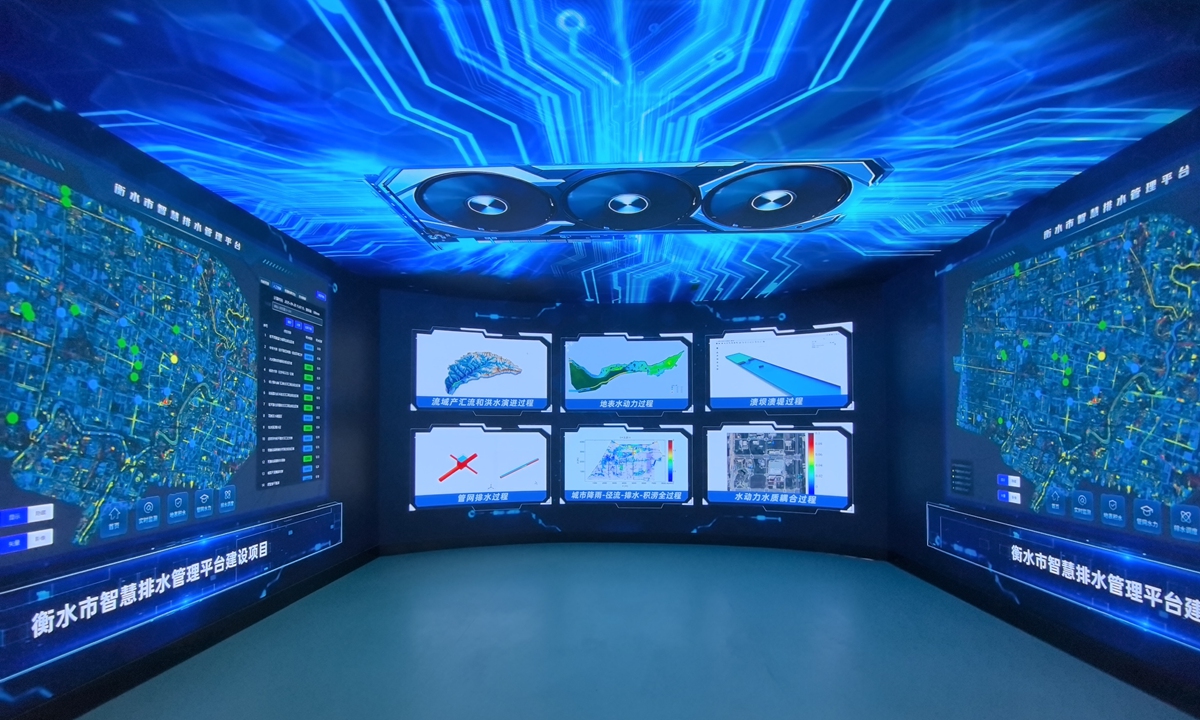
A 3D live-scene display lab in Xi'an that oversees stormwater drainage performance in Hengshui, North China's Hebei Province Photos: Courtesy of Xi'an University of Technology
During Typhoon Muifa in 2022, Haishu district in Ningbo, East China's Zhejiang Province, recorded a regional rainfall of 367 millimeters. Using GAST as its core technology, the local flood forecasting platform integrated weather forecasts, AI algorithms and real-time monitoring data to provide rolling three-hour flood risk predictions.
Post-event assessments showed that predicted risks at most locations matched actual flooding conditions. The average relative error between predicted and observed maximum water depths was 13 percent.
The GAST model was also integrated into a smart rain and flood management platform in Qinhan new city area in Xianyang of Shaanxi, and during a rainstorm warning in July 2022, the platform provided continuous monitoring and forecasts. Based on the results, local authorities shifted from routine inspections to targeted monitoring of flood-prone areas and optimized emergency drainage operations.
The model is also being applied to mountain torrent prevention, as it can simulate rapidly changing flows in complex terrain and, combined with machine learning, complete forecasts within seconds. For reservoirs and rivers, it supports sudden and gradual dam-break simulations.
In June 2026, the model was presented at a national symposium on flood risk mapping achievements. The technology has since been applied by water resources, emergency management and urban development authorities, expanding from Shaanxi to multiple provinces and regions across China.
Looking ahead, the research team is developing a framework that further keeps up with the pace focusing on AI technologies. "Currently, the system operates based on weather forecast, therefore, AI will increase efficiency by using historical cases and real-time monitoring data to correct errors and update forecasts dynamically," Hou said.
。
Current article:http://b9p.xuanliaruamibinmilangca.shop/list_sd4/7sswgul.html
Published on:07:46:03