舞出我人生
Can US afford cost of clean-energy protectionism in race for AI capabilities?_我的网站

一 | 週日早上,WNBA常規賽火熱進行,火花主場迎戰陽光。
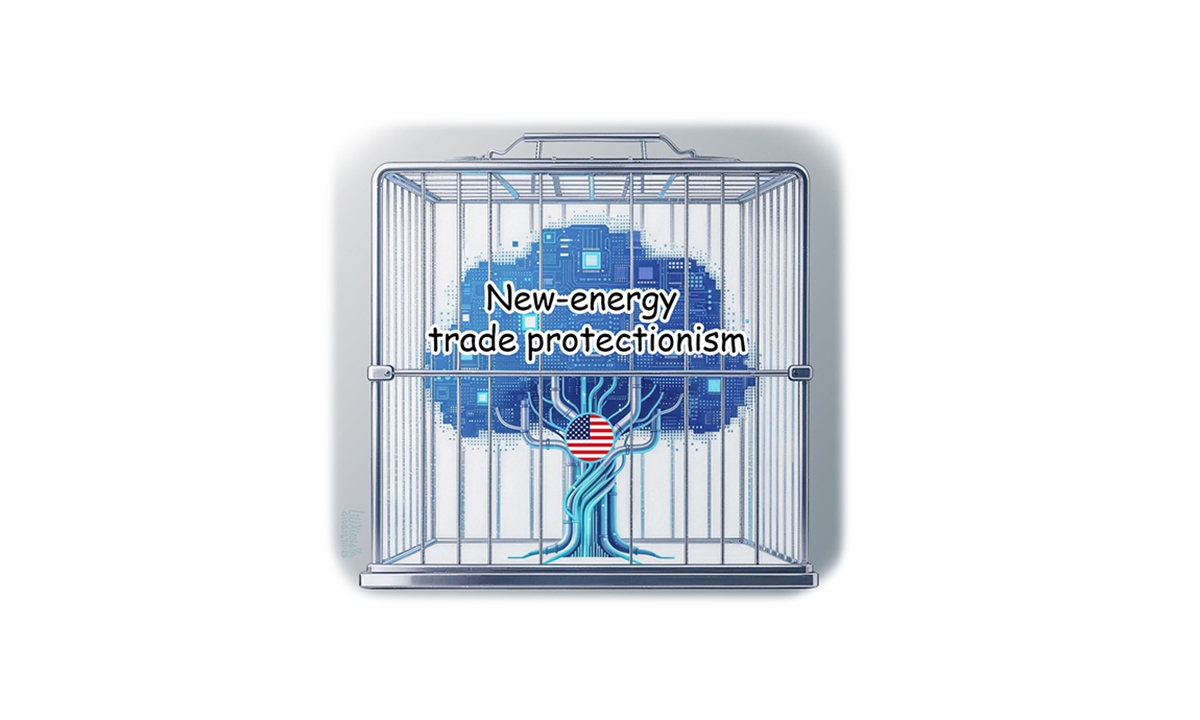
Illustration: Liu Xiangya/GT
Recent media reports have questioned whether a natural gas plant built to power an Amazon data center project in Texas could become the largest climate polluter in the US. The controversy, whatever the eventual outcome, offers a reality check for America's artificial intelligence (AI) drive.
It exposes a growing contradiction: The US is racing to expand its AI capabilities, yet its protectionist trade policies are making it harder and more costly to access some of the clean-energy technologies needed to sustain that expansion. This raises a broader question: Can an energy-intensive AI race afford the costs of renewable energy protectionism?
The US is entering a new era of rising electricity demand. Data centers, the backbone of the AI economy, are emerging as one of the fastest-growing sources of power consumption. Much of that demand is still being met by fossil fuels: The International Energy Agency reports that natural gas supplies more than 40 percent of the electricity used by data centers in the US, making it their largest source of power.
So, it's not surprising that the expansion of data centers has raised concerns over their environmental impact and the pressure they could place on local power systems and electricity bills. A Gallup survey conducted in March found that seven in 10 Americans opposed the construction of AI data centers in their local area, including 48 percent who strongly opposed such projects.
The findings point to a broader challenge for the US: The race to develop AI is increasingly becoming a race to meet growing energy needs. Addressing this challenge will require more than advances in computing technology; it will also depend on an energy system capable of delivering large amounts of reliable, affordable and cleaner power. That, in turn, will require faster development and broader deployment of clean-energy technologies, from solar power to energy storage.
Yet in the clean-energy sector, the US has increasingly relied on protectionist trade measures that limit access to cost-competitive products from global markets. The country has placed greater emphasis on expanding domestic manufacturing capacity, but rebuilding entire clean-energy supply chains at home is a costly and time-consuming process. Even if expanded domestic production is achieved, it is likely to come at a higher cost, making the deployment of renewable technologies more expensive and potentially slower.
The solar industry offers a clear illustration of this policy direction. The US has continued to expand trade barriers in the sector. Reuters reported that the US government announced on Thursday a series of price floors and a 15 percent tariff on products made from polysilicon, a raw material used in solar panels.
The challenge lies in the limited scale of the US polysilicon industry. Reuters reported that the country has two polysilicon factories. Against this backdrop, relying on domestic polysilicon production while restricting access to imports runs counter to the goal of expanding solar power in the US. The country risks creating barriers that ultimately constrain its own access to the global supply chains needed for growth.
The pressing issue for the US is the speed at which new power demand is emerging. The expansion of data centers is creating electricity needs that cannot wait for domestic clean-energy capacity to develop gradually. Global supply chains can provide the scale and speed required in the near term. By narrowing access to these sources, the US risks turning clean-energy policy into a drag on the infrastructure needed for its AI race.
The US has placed AI high on its economic and technological agenda. The outcome of this race will matter greatly, as financial markets are also watching whether America can turn its AI efforts into commercial success.
This leaves the US with a difficult choice: Can it afford the cost of clean-energy protectionism while racing to build AI infrastructure? The answer may be no. Trade barriers that limit access to competitive renewable technologies could ultimately become a constraint on the AI expansion that Washington is seeking to accelerate.
The author is a reporter with the Global Times. [email protected]
。兩隊都已經徹底無緣今季季後賽,剩餘賽程都是例行公事,不過陽光的強力內線格蓮娜以及均場得分接近雙位數的艾莉亞愛華士都傷缺,實力大受打擊,今鋪不妨看好火花重返勝軌。

二 |
火花在賽季上半段表現尚算交到功課,勝率維持在五成左右,但從七月中旬不敵夢想開始,火花陷入低潮,兩波六連敗同季後賽講拜拜。

三 | 8月初交易走K.柏林,此舉更似是為火花步入重建作鋪墊。當家球星奧胡米克雖然已經36歲,但她今季均場還能交出16.7分和8.7個籃板,賽季至今只缺席過1場比賽,求戰欲強烈。而且火花今季最長連敗場次只有6場,目前正處於六連敗的她們肯定想盡快擺脫頹勢,今鋪面對排名倒數第二的陽光,火花誓要一雪前恥。

四 |
陽光上仗23分的分差慘敗給王牌,今季勝場數還未達到雙位數。

五 | 作客出戰的陽光更是令人擔憂,今季作客3勝14負,只有排名墊底的暴風比她們差,球隊目前也處於作客六連敗的泥潭當中,當中3場淨負至少20分。更讓陽光感到無力的是,球隊近2次走訪火花都輸波,兩場比賽她們都是上半場領先,下半場被翻盤。加上兩名主將的受傷,奧莉維婭奧杜達顯得獨木難支,陽光此行只能接受空手而回的事實。

六 |
Current article:http://b9p.xuanliaruamibinmilangca.shop/b1h/20260826/4404.html
Published on:13:15:43

 奇瑞在上海成立绿能慧碳科技公司
 What's Really Behind US Defense Firm's Botched Deal to Acquire Pegasus Spyware Maker?
 美元理财收益优势减弱,外贸企业结汇升温
 XBOX One Insider会员新功能:主页改进、本地存档管理及个人资料徽章
 七夕佳节,以“7”相会,巧礼赠佳人!
 利物浦3:1胜曼城夺得社区盾杯冠军
查看所有0条评论>>